Kriterion vs MyFitnessPal
MyFitnessPal is the app most people mean when they say “a calorie tracker.” It built the category, and its database is the biggest there is, which is genuinely the point of it, and also the thing this page is about. A database that large is large because anyone can add to it, and once six versions of the same yoghurt disagree, the size stops helping you. The other difference is what each app does to stay free.
The database really is the largest of its kind, and it has very probably already got the regional or discontinued thing you are eating. Every app here, ours included, is standing on a category MyFitnessPal made. Where we part company is not the crowdsourcing; it is what checks it.
What a bigger database is actually worth
Scanning a barcode and finding something is the moment a food app either works or doesn’t, and MyFitnessPal built its name on sheer volume of entries for that moment. We are not going to pretend to have as many entries as they do. We answer the moment differently.
What we do instead is tell you where each number came from. Every entry is badged by how its figures were produced (laboratory analysis, a manufacturer’s own label, a published restaurant menu, a community submission), and something typed in by hand gets no badge at all rather than an invented one. When six entries for the same product disagree, that badge is the difference between picking one and guessing.
It goes one level further. When a source never measured something, we say it was not measured rather than showing you a zero, and we tell you how many of the nutrients we look for were actually reported for that food. A blank and a zero are different facts. An app that quietly turns the first into the second is telling you your diet is better or worse than the evidence supports.
What free costs
MyFitnessPal is free because it carries advertising, and over the years several things that used to be free stopped being free. That is a business model, not a scandal, and it paid for the database everyone benefits from.
Ours is a subscription, and the consequence is that the daily part stays free without needing to be paid for by anything else. Logging, searching, your full history, the built-in programmes and the workout logger cost nothing and carry no advertising, now or later. What Premium buys is the measured burn rate and the thinking layer on top of your data, not permission to keep using the app you already set up.
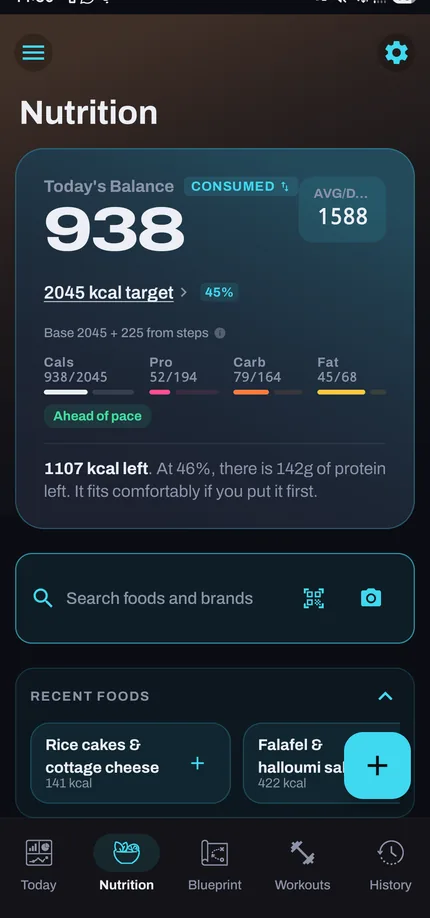
No ads, and every number sourced The same screen in MyFitnessPal carries advertising on the free tier, and its entries are mostly user-submitted. Here every meal shows its own calories and macros without a subscription, and every food is marked with where its figures came from: a government lab, a manufacturer's own panel, a published menu. The figures shown are from a seeded demo account, not a real person.
| Kriterion | MyFitnessPal | |
|---|---|---|
| Ads on the free tier | None, on any tier. There is no advertising in the app at all | Yes, throughout logging and browsing, on the free tier |
| Food data source | Over a million entries: UK government lab data (CoFID), USDA, Open Food Facts and real UK chain menus, each one marked with where it came from | Mostly user-submitted, with no source shown. Duplicate listings for the same food with different numbers are a long-standing, widely reported problem |
| Calorie target | Measured from your own logged intake against your weight trend, with a published margin of error | A standard formula from your stats. It doesn't adjust itself as your data comes in |
| Macros per meal | Every meal in your journal shows its own calories and protein, carbs and fat, on the free tier | Daily totals only on the free tier. Seeing the breakdown per meal is sold as part of Premium, under the name Macros By Meal |
| Macros inside a recipe | Every ingredient's own calories, macros and micronutrients, on the free tier | Not broken down per ingredient once a recipe is logged |
| Menstrual cycle tracking | Built in, shown beside readiness as context for training | Not offered |
| Training | Sets, reps, RIR, readiness, a HIIT timer with spoken interval cues | Basic exercise logging; not built for structured strength training |
| Data leaving your phone | Your health data stays on the phone unless you choose to back it up or share it. Today a search term leaves to look up food, and so do crash reports and usage analytics; both are on by default during the beta and each has its own switch in Settings. Label and scale photos are read on-device. Anything stored off the phone later is encrypted with a key only you hold. Full detail in the privacy policy | Not documented to the same level of detail |
| Community & brand recognition | New. No install base, no friends feature yet | The largest food-logging community there is, with a name everyone already knows |
MyFitnessPal also has fifteen years, a household name and a company behind it. Kriterion is new, and its choices are deliberate: a sourced database you can check entry by entry, and food, training and recovery joined up in one app rather than spread across three.
The problem isn't crowdsourcing. It's unchecked crowdsourcing.
A crowdsourced database's strength is coverage: someone, somewhere, has probably already logged your exact meal. That is genuinely valuable, and Kriterion uses crowdsourced data too and Open Food Facts is one of the sources it draws on.
The weakness is not that people contribute. It is that in most apps nothing checks what they contribute and nothing records where it came from, so the same product ends up listed several times with different calorie counts and you have no way to tell which one was measured.
Kriterion takes contributions and corrections too. You can report a food as wrong, report a barcode pointing at the wrong product, or photograph the packet's own nutrition panel as evidence. The difference is what happens next. A label photo is checked on your device against the existing record, and if the panel doesn't match the food, nothing is submitted and you're told why. Anything that does go through is queued for review rather than overwriting the entry, so it can never outrank a lab measurement. And every entry shows its source, so you can always see whether a number came from a government lab or from somebody's best guess.
A target that reacts to you, not a formula
MyFitnessPal's calorie goal comes from your height, weight, age and activity level, run through a standard equation, and stays put until you change your stats yourself. Kriterion starts the same way, then replaces that estimate with one measured from your own logged intake and weight trend as soon as there's enough data to trust it, and shows you the margin of error on that number rather than presenting a guess as fact.